
SEO Do’s and Don’ts: Best Practices for Small Businesses Search …
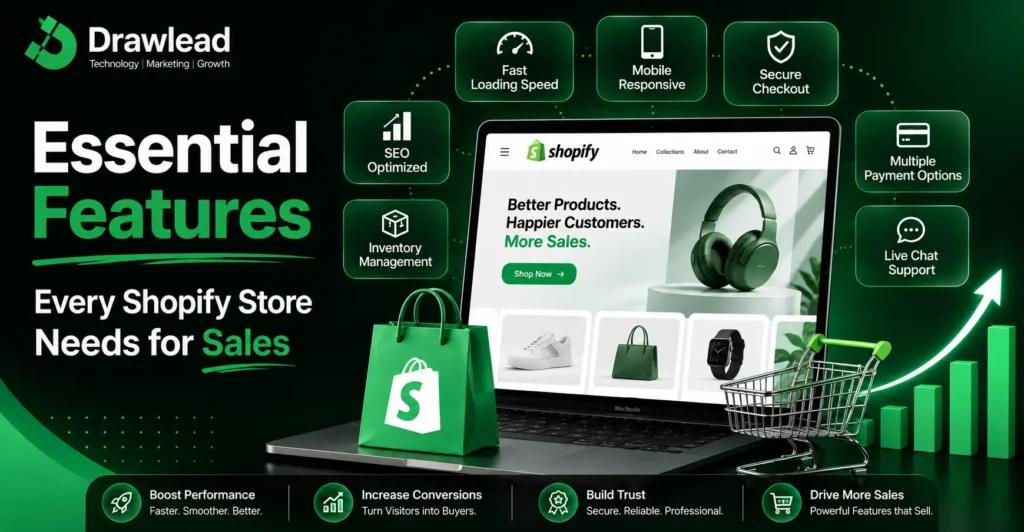
Essential Features Every Shopify Store Needs for Sales
Introduction
A Shopify store should not only look good. It should help customers browse products easily, trust the brand, add products to cart, complete checkout, and contact the business when needed. Many ecommerce brands lose sales because their store has poor product pages, slow loading speed, no trust signals, weak checkout flow, or no tracking setup.
That is why understanding Shopify ecommerce features is important for every business owner. The right features can improve customer experience, enquiries, WhatsApp leads, and sales opportunities. Drawlead helps businesses build Shopify stores with practical sales-focused features, clean design, SEO structure, and conversion tracking.
What Are Shopify Ecommerce Features?
Shopify ecommerce features are the tools, functions, and design elements that help an online store sell products smoothly.
These features may include product pages, cart, checkout, payment gateway, shipping setup, customer reviews, discount codes, SEO settings, mobile responsive design, analytics, abandoned cart recovery, and app integrations.
A good Shopify ecommerce store should make shopping simple from the first visit to final payment.
Why Are Shopify Store Features Important for Businesses?
Shopify store features directly affect customer trust and sales. If users cannot find products, understand prices, view images clearly, or complete checkout easily, they may leave the website.
Good Shopify functionality helps businesses with:
- Better user experience
- Higher product enquiries
- More completed checkouts
- Better mobile shopping
- Improved customer trust
- More WhatsApp and phone call leads
- Better sales tracking
- Improved ecommerce SEO
A Shopify store should be built for both design and performance.
Key Benefits of Essential Shopify Store Features
1. Better Product Visibility
A well-structured store helps customers find the right product quickly through categories, filters, collections, and search.
2. More Customer Trust
Clear images, reviews, return policy, shipping details, and secure payment options can reduce buyer hesitation.
3. Higher Conversion Chances
A clean product page, simple checkout, and clear CTA buttons can encourage customers to complete their purchase.
4. Better Mobile Experience
Most users browse ecommerce websites on mobile. Shopify mobile responsive design helps customers shop comfortably on any device.
5. Better Marketing Performance
With analytics, Meta Pixel, and conversion tracking, businesses can understand which campaigns bring traffic, enquiries, and sales.
Important Features Every Shopify Store Needs for Sales
1. Mobile Responsive Design
Your Shopify store should work perfectly on mobile, tablet, and desktop. Product images, buttons, menus, cart, and checkout should be easy to use on small screens.
2. Optimized Product Pages
Shopify product page optimization is one of the most important sales features. Each product page should include:
- Clear product title
- High-quality images
- Short product description
- Benefits and features
- Price and offers
- Size or variant options
- Reviews
- Add to cart button
- Delivery and return information
A confusing product page can reduce sales.
3. Fast and Simple Checkout
Shopify checkout optimization helps reduce friction. Customers should be able to add products, review cart details, choose payment, and place orders without confusion.
Avoid unnecessary steps, unclear shipping costs, and complicated forms.
4. Secure Payment Gateway Setup
Shopify payment gateway setup is important for customer trust. A store should support suitable payment options such as cards, UPI, net banking, wallets, and cash-on-delivery if relevant.
5. Clear Shipping and Delivery Information
Customers want to know when they will receive their order. Clear shipping charges, delivery timelines, and return policies can reduce cart abandonment.
6. Customer Reviews and Trust Signals
Reviews, testimonials, secure checkout badges, return policy, contact details, and business information help customers feel confident before buying.
7. WhatsApp and Call Button
Some customers may not buy immediately. They may want to ask about size, price, delivery, customization, or availability. A WhatsApp button and call button can help convert visitors into enquiries.
8. Abandoned Cart Recovery
Shopify abandoned cart recovery helps businesses follow up with users who started checkout but did not complete the purchase. This can support better sales recovery.
9. SEO Setup
Shopify SEO setup helps search engines understand your product pages and collections. Important SEO elements include:
- SEO-friendly URLs
- Meta titles
- Meta descriptions
- Image alt text
- Product content
- Collection page content
- Internal linking
- Fast loading pages
10. Analytics and Conversion Tracking
Google Analytics, Google Search Console, Meta Pixel, and conversion tracking help business owners understand traffic, product views, cart actions, purchases, and campaign performance.
Best Practices for Shopify Store Optimization
Follow these simple best practices:
- Keep the design clean and easy to use.
- Add clear product categories and filters.
- Use strong product images.
- Write simple product descriptions.
- Add clear CTA buttons.
- Make checkout fast.
- Use WhatsApp and call buttons.
- Add reviews and trust elements.
- Track conversions.
- Improve SEO for products and collections.
Real-World Use Cases
A jewellery brand can use product filters, reviews, WhatsApp enquiries, and collection SEO to improve sales.
A skincare brand can use product benefits, before-after style visuals, reviews, and subscription options.
A fashion brand can use size charts, product variants, return policy, and abandoned cart recovery.
A local Chennai ecommerce business can use Shopify website development with SEO, WhatsApp integration, and Meta Pixel tracking to improve enquiries and marketing results.
Step-by-Step Process to Build a Sales-Focused Shopify Store
- Understand the product category and target audience.
- Select the right Shopify theme.
- Create a clean store structure.
- Add product categories and collections.
- Optimize product pages.
- Set up payment gateway and shipping.
- Add WhatsApp, call button, and enquiry options.
- Set up SEO basics.
- Add analytics and Meta Pixel.
- Test mobile, cart, checkout, and speed before launch.
Basic Store vs Sales-Focused Shopify Store
Feature | Basic Shopify Store | Sales-Focused Shopify Store |
Design | Simple layout | Conversion-focused layout |
Product Pages | Basic details | Images, benefits, reviews, CTA |
Checkout | Default setup | Optimized and tested |
Lead Options | Limited | WhatsApp, call, enquiry form |
SEO | Minimal | Product and collection SEO |
Tracking | Not always included | GA, GSC, Meta Pixel |
Goal | Online presence | Sales and enquiries |
Conclusion
A successful Shopify store needs more than product uploads and a theme. It needs the right Shopify ecommerce features to support trust, speed, mobile experience, checkout, SEO, tracking, and customer communication.
If you want a Shopify store that is designed for enquiries, WhatsApp leads, sales opportunities, and long-term ecommerce growth, contact Drawlead. Our team can help with Shopify development, WordPress development, ecommerce website development, SEO, Meta Ads, AI-powered website solutions, and conversion-focused website support.
Recent Posts
How AI Improves Shopify Store Design and Sales Conversion Introduction …
Frequently Asked Questions
Essential features include product pages, cart, checkout, payment setup, shipping setup, reviews, SEO, WhatsApp button, analytics, and abandoned cart recovery.
Yes. The right Shopify features may improve customer trust, product visibility, checkout completion, and lead generation.
Yes. Shopify stores need SEO to help product and collection pages appear in search results and attract organic traffic.
WhatsApp helps customers ask questions quickly before buying. It can improve enquiries and customer support.
Yes. Drawlead provides Shopify ecommerce development services, store setup, website development, SEO support, and lead generation features.